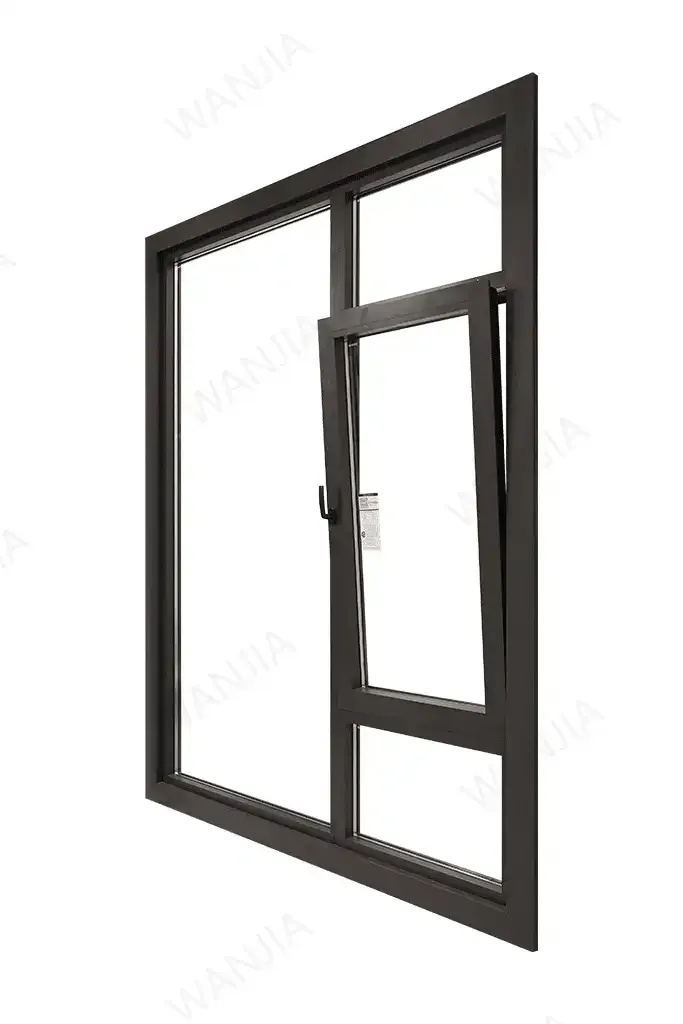
Tilt and turn windows for sale from WANJIA Hiseng give you a practical European window system without the guesswork. The sash tilts inward at the top for ventilation, or swings fully open like a casement for cleaning and emergency egress. Builders, dealers, architects, and homeowners across North America use these windows in new construction and renovation projects where air flow, security, and easy maintenance matter.
This page covers the two product families available on this site: aluminum-clad wood tilt and turn windows with a solid wood interior and aluminum exterior, and all-aluminum thermal break tilt and turn windows in the 91, 70, and K80 series. Both families use the same European tilt-turn hardware standard and German hardware brands like ROTO, SIEGENIA, and CMECH. The windows are manufactured in Foshan, China, and shipped worldwide.
What You Can Buy on This Site
WANJIA Hiseng offers two distinct tilt and turn window lines. The right choice depends on your climate, budget, and interior finish requirements.
Aluminum-Clad Wood Tilt and Turn Windows
This line pairs a solid wood interior with a protective aluminum exterior. The wood gives you a warm, natural appearance inside the room. The aluminum cladding resists moisture, corrosion, fading, and harsh weather on the outside. This combination reduces maintenance and extends the window's lifespan compared to an all-wood frame.
The aluminum-clad wood tilt and turn window includes a robust multi-point locking system. Hardware comes from ROTO, SIEGENIA, or CMECH. You can specify double, triple, or Low-E glass. Exterior finishes include powder coating, anodizing, and wood-grain options. The tilt position allows ventilation while the sash stays locked in its track. The turn position opens the full sash for cleaning or a wider opening.
Aluminum Tilt and Turn Windows
The all-aluminum line includes three series: 91, 70, and K80. All are thermal break designs, which means a non-conductive barrier separates the interior and exterior aluminum to reduce heat transfer.
The 91 series uses 6060-T66 aluminum with a 1.8 mm wall thickness and 2.0 mm local reinforcement. Its standard glass make-up is 5+16A+5+16A+5 triple glazing. The whole-window U-factor is 1.4 W/m²K, and the sound reduction is Rw 37 dB. This series carries ENERGY STAR, NFRC, and CSA certificates.
The 70 series has a U-factor of 2.0 W/m²K and Rw 30 dB. Glass options go up to 5+27A+5. Built-in blinds are available. The K80 is a large automatic tilt and turn window with a U-factor of 1.4 W/m²K, Rw 37 dB, and a smart control panel for motorized operation.
All aluminum series accept custom sizes within the factory's production range. Color options include 9 aluminum colors and 26 steel colors, plus wood-grain finishes on request.
Why Builders and Dealers Choose These Windows
North American builders often specify tilt and turn windows for multi-family buildings, custom homes, and commercial projects. The hardware standard is familiar to European-trained architects and increasingly common in high-performance building envelopes.
The multi-point locking system is a key difference from typical North American sliding or single-hung windows. When the handle is turned to the closed position, locking points engage around the sash perimeter. This creates a tighter seal and better resistance to forced entry. In the tilt position, the sash remains locked at the bottom while the top tilts inward a few inches. Air enters without creating a large opening.
For dealers, WANJIA Hiseng offers OEM and ODM programs. You can order under your own brand, choose hardware and finish packages, and receive training courses through the dealer or agent program. Bulk orders ship worldwide with wooden box and wooden frame packing.
Specifications That Matter for North American Projects
When you compare tilt and turn windows for sale, look at the frame material, thermal break, glass package, and hardware. These four items determine most of the window's performance.
| Series | Frame | Typical Glass | U-factor | Sound Reduction | Certifications |
|---|---|---|---|---|---|
| 91 series | Aluminum thermal break | 5+16A+5+16A+5 | 1.4 W/m²K | Rw 37 dB | ENERGY STAR, NFRC, CSA |
| 70 series | Aluminum thermal break | Up to 5+27A+5 | 2.0 W/m²K | Rw 30 dB | None listed |
| K80 series | Aluminum thermal break | Not specified | 1.4 W/m²K | Rw 37 dB | None listed |
| Aluminum-clad wood | Wood interior, aluminum exterior | Double, triple, Low-E | Not specified | Not specified | None listed |
The 91 series is the only aluminum tilt and turn window on this site with ENERGY STAR, NFRC, and CSA certificates. If your project requires certification-backed performance data for code compliance or utility rebates, specify the 91 series. The aluminum-clad wood line uses the same ROTO, SIEGENIA, and CMECH hardware but does not carry those certifications.
For low U-value projects, see our passive house windows guide. It explains how thermal break frames, triple glazing, and multi-point seals work together to reduce heat loss. The 91 series with a U-factor of 1.4 W/m²K is a common starting point for those conversations. This is not a passive house certification claim, just a practical configuration guide.
Ordering, Lead Time, and Shipping
WANJIA Hiseng works on a project basis. You send your window schedule, sizes, finish choices, and hardware preferences. The factory reviews the details and returns a quote within 3 hours on average.
Production lead time is usually 25-30 business days, depending on the design, materials, and order volume. Payment terms include bank transfer or T/T. Trade terms are EXW, FOB, or CIF. After shipment, you receive a tracking number or logistics serial number to follow the container.
Sample orders are supported before bulk purchase. This lets you check the frame profile, finish quality, and hardware operation before committing to a full container. The factory does not publish a minimum order quantity; each project is quoted individually.
Installation and Support
WANJIA Hiseng does not send installers to your site. Instead, you get installation videos and written guidance after the goods arrive. The technical team also provides a measurement solution based on your project conditions. Remote assistance continues until the project is finished.
This model works well for builders and dealers who already have installation crews. The tilt and turn hardware is standard across Europe, so any crew familiar with European windows can handle the installation. The factory's after-sales service team is reachable directly for questions during and after installation.
Warranty depends on the specific product and contract terms. Repair or replacement is handled during the warranty period according to the agreed terms. Make sure the warranty scope and duration are written into your purchase contract before production starts.
Frequently Asked Questions About Buying Tilt and Turn Windows
Here are answers to the questions we hear most often from first-time buyers.
Are tilt and turn windows secure?
Yes. The multi-point locking system engages several locking points around the sash when closed. In the tilt position, the sash remains locked at the bottom, so you get ventilation without a large opening. The hardware from ROTO, SIEGENIA, and CMECH is designed for repeated use and forced-entry resistance.
What is the difference between aluminum-clad and all-aluminum tilt and turn windows?
Aluminum-clad windows have a wood interior and aluminum exterior. All-aluminum windows are aluminum inside and out. Aluminum-clad gives you a warm interior look with weather protection outside. All-aluminum is lower maintenance and often less expensive. Both use the same tilt-turn hardware standard.
Can I order custom sizes and colors?
Yes. WANJIA Hiseng manufactures to your project's window schedule. You can choose from 9 aluminum colors, 26 steel colors, powder coating, anodizing, and wood-grain finishes. Glass options include double, triple, and Low-E. Hardware brand is specified per order.
For more detail on the European hardware standard and how it differs from North American windows, read what is a tilt and turn window. You can also compare the two product families on the aluminum tilt and turn windows and aluminum-clad wood tilt and turn windows pages.